Street Network 101
why the shape of a city decides its traffic
 ▶ Click to start — full screen
A road is a line between two points. A lane is a thing with a direction, a side of the road, a place it comes from and a set of places it may go. Nothing about the second is drawn by hand — all of it is derived from the first, and that derivation is the whole subject:
- Where two roads cross, who owns the overlap?
- Which side does a car drive on, and how far from the centre?
- Arriving at a junction, which turns are legal, and which two turns may not be taken at the same moment?
- And when a road simply stops — what happens to a car on it?
Once the lane graph exists, a second question becomes askable, and it is the one the lab is really for: how much of a network’s behaviour is decided by its shape alone?
What you can try
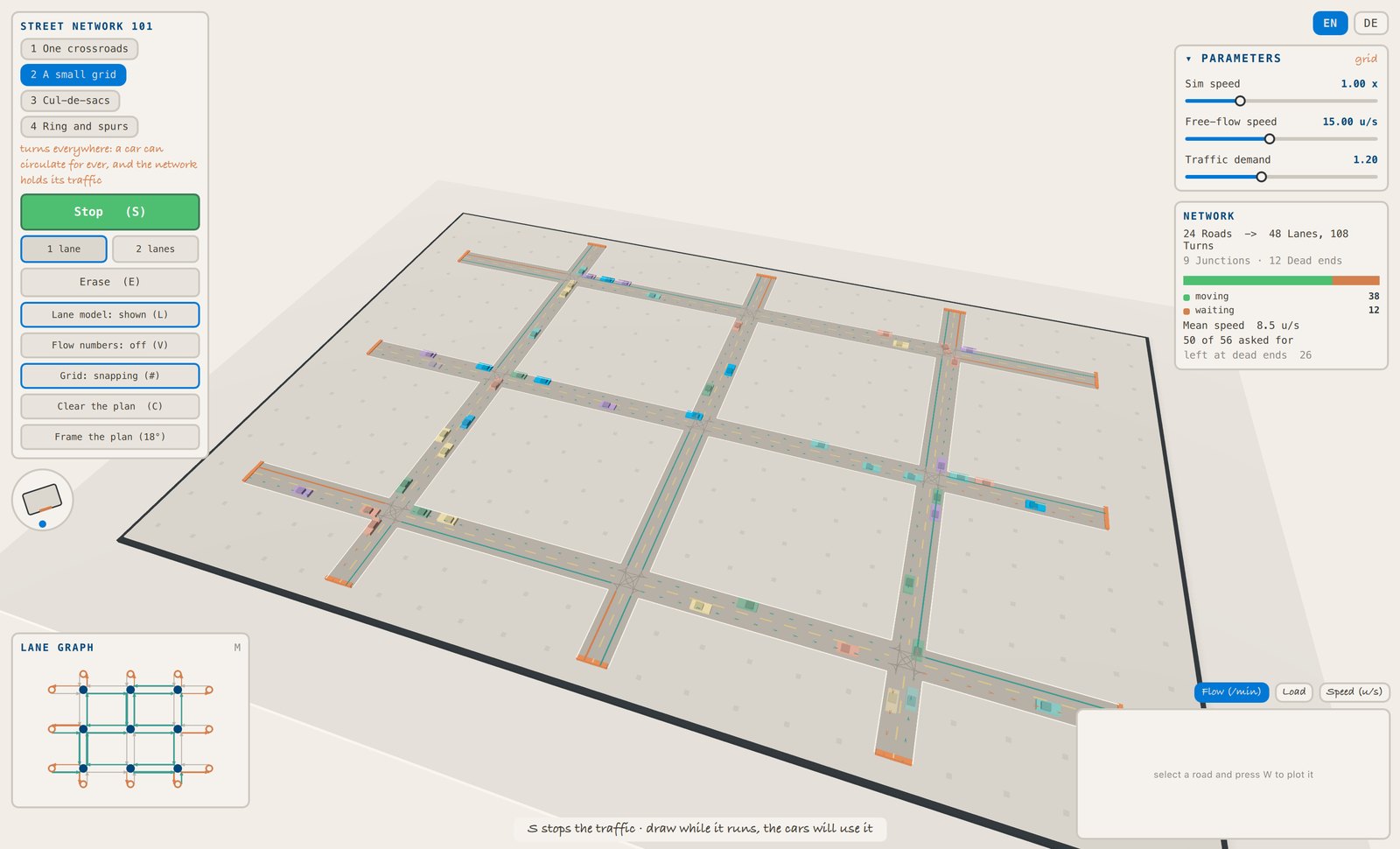
Each preset is a prepared situation, and the lab says what is worth noticing in it:
- One crossroads — every turn leads off the plan, so cars leave almost as fast as they arrive
- A small grid — turns everywhere: a car can circulate for ever, and the network holds its traffic
- Cul-de-sacs — a tree — every branch ends, so the plan quietly bleeds traffic
- Ring and spurs — the ring keeps traffic circulating while the spurs drain it
Running it
Labs run in the Dojo from a Clayground checkout:
cmake -B build && cmake --build build
./build/bin/claydojo --sbx labs/street-network-101/Sandbox.qml
Press ? inside any lab for its key map, and T where a guided tour is offered.